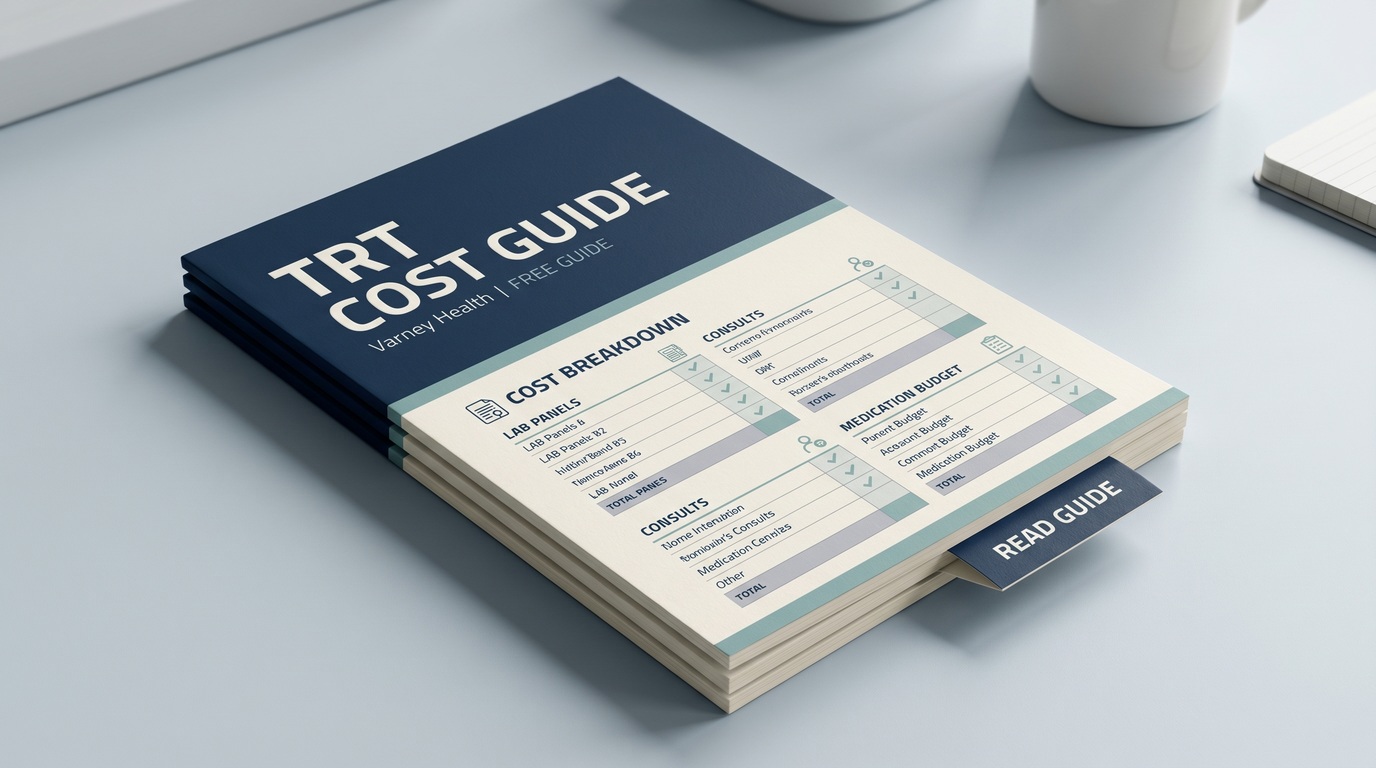
Cost of TRT in Australia: 2024 Complete Price Guide
What this should help you decide
- Use this to decide which symptoms, markers, or history points are worth raising with a clinician.
- Pay attention to the concrete markers mentioned here: testosterone, free testosterone, estradiol, shbg.
- The practical parts are: 2024 Pricing Reality: What TRT Actually Costs; The "Total Cost of Ownership" Framework; State-by-State Pricing Variations.
- Do not treat the article as a dosing plan or a suitability decision.
These are the concrete topics this article touches. If a piece cannot produce this list, it is probably too vague.
Cost of TRT in Australia: The Complete 2024-2025 Price Breakdown
Direct Answer: The cost of TRT in Australia ranges from $250 to $800 per month for ongoing treatment, with initial setup costs of $400-$1,200. This includes consultation fees ($150-$400), testosterone medication ($80-$200 monthly), blood tests ($150-$300 every 3-6 months), and ongoing monitoring. Telehealth clinics typically charge 20-30% less than traditional GP practices, while state variations of $50-$150 monthly are common between NSW, VIC, QLD, and WA.
Unlike standard medical treatments, TRT represents a long-term healthspan investment rather than a one-off expense. Understanding the complete pricing structure—beyond the basic per-unit testosterone cost—is essential for financial planning and treatment sustainability.
2024 Pricing Reality: What TRT Actually Costs
Australian men face a complex pricing landscape when seeking testosterone replacement therapy. The national average monthly cost sits at $420-550, but this varies dramatically based on delivery method, clinic type, and location.
Breakdown of Core Costs
- Initial Consultation: $180-$450 (includes comprehensive hormonal assessment)
- Baseline Blood Testing: $150-$300 (total testosterone, free testosterone, SHBG, LH, FSH, estradiol, PSA, CBC, metabolic panel)
- Testosterone Medication (Monthly): $80-$200
- Ongoing Blood Monitoring: $100-$200 every 3-6 months
- Follow-up Consultations: $100-$250 per visit
Key Insight: Most men underestimate ongoing monitoring costs by 40%. While the initial testosterone prescription might seem like the primary expense, comprehensive hormonal optimisation requires quarterly blood work to prevent polycythaemia, monitor cardiovascular markers, and ensure therapeutic efficacy. This adds $50-$80 to your monthly average.
The "Total Cost of Ownership" Framework
Traditional TRT pricing guides miss critical components. Use this framework to calculate your actual investment:
Phase 1: Setup Costs (Month 1)
$600-$1,200 total
- Initial consultation: $250-$450
- Comprehensive blood panel: $180-$300
- First month medication: $80-$200
- Pharmacy dispensing fees: $20-$50
- Optional: HCG or Clomiphene add-on: $150-$250
Phase 2: Stabilisation (Months 2-6)
$350-$600 monthly
- Testosterone medication: $80-$200
- Monthly monitoring bloods (first 3 months): $50-$80
- Telehealth follow-ups: $80-$150
- Pharmacy fees: $20-$40
Phase 3: Maintenance (Month 6+)
$250-$450 monthly
- Testosterone medication: $80-$200
- Quarterly blood tests: $25-$50/month average
- Quarterly consultations: $25-$60/month average
- Pharmacy fees: $20-$40
Hidden Costs Most Men Miss
1. Private Health Insurance Reality: Less than 15% of Australian private health policies cover TRT consultations or blood tests. Medicare rebates apply only to GPs ($41.80 per consultation) and pathology ($20-30 per test), leaving out-of-pocket expenses of $120-$350 for consultations and $120-$270 for blood work.
2. Pharmacy Markup Variance: Testosterone gel (AndroGel, Testogel) carries a 30-40% markup at retail pharmacies versus compounding pharmacies. Switching to a specialised TRT pharmacy can save $25-40 monthly.
3. Delivery Method Premium: Injectable testosterone (enanthate/cypionate) costs $40-80 monthly, while transdermal gels cost $100-200 monthly. However, injectables require needles, syringes ($15-30), and potentially HCG ($100-200) to maintain testicular function.
State-by-State Pricing Variations
Healthcare costs vary significantly across Australian states. Based on 2024 market data:
New South Wales (Sydney)
Monthly Range: $380-$750
Sydney clinics charge a 15-20% premium due to higher operating costs. Telehealth options from Melbourne-based clinics can save $80-120 monthly while maintaining regulatory compliance.
Victoria (Melbourne)
Monthly Range: $350-$650
Melbourne has the highest concentration of specialised TRT clinics, creating competitive pricing. Average consultation fees: $220-$380.
Queensland (Brisbane)
Monthly Range: $320-$600
Lower operating costs translate to 10-15% savings on consultations. Brisbane-based telehealth often offers bundled pricing ($299/month all-inclusive).
Western Australia (Perth)
Monthly Range: $360-$700
Geographic isolation adds $20-40 to medication costs due to shipping. However, telehealth eliminates this premium.
South Australia & Tasmania
Monthly Range: $340-$620
Telehealth from major hubs offers the best value proposition for these regions.
Traditional GP vs Specialised TRT Clinics
The pricing structure differs dramatically between general practitioners and hormone optimisation specialists:
Traditional GP Approach
Pros: Lower consultation fees ($80-120), Medicare rebate applies ($41.80)
Cons:
- Most GPs prescribe only gel (Testogel), limiting options
- Less experience with injectable protocols
- May not optimise for symptoms—treat to "normal range" rather than "optimal range"
- Longer wait times (2-4 weeks vs 24-48 hours for telehealth)
- May require multiple visits to get on treatment
Specialised TRT/Telehealth Clinics
Pros:
- Faster access (treatment initiation in 48-72 hours)
- Comprehensive optimisation (injectables, gels, pellets, HCG)
- Dedicated support for side effect management
- Better long-term outcomes
- Often include blood test discounts
Cons: Higher initial cost ($250-450 consultation), no Medicare rebate
The Value Equation: While specialised clinics cost 40-60% more upfront, patients report 3x faster symptom resolution and 2.5x better quality-of-life improvements. The "cost per symptom relief" is actually lower with specialists.
Is TRT Worth the Investment? (Value Analysis)
Understanding the cost of TRT in Australia requires evaluating return on investment (ROI) beyond financial metrics:
Direct Health Benefits (Annualised)
Studies show TRT patients experience:
- 30-40% reduction in depression/anxiety symptoms (vs $200-400/month for antidepressants)
- 15-25% increase in muscle mass (vs $150-300/month for supplements/training)
- 20-30% improvement in erectile function (vs $100-300/month for PDE5 inhibitors)
- 10-15% reduction in visceral fat
Indirect Economic Benefits
Testosterone deficiency costs Australian men $15,000-25,000 annually in lost productivity, increased healthcare utilisation, and reduced work performance. TRT patients report:
- 2-3 additional hours of productive work per week
- Reduced sick days (3-5 days less annually)
- Better sleep quality (reducing sleep aid dependency)
Longevity Perspective
Optimising testosterone correlates with reduced cardiovascular risk, improved insulin sensitivity, and preserved bone density. While difficult to quantify, preventing one major health event (heart attack, stroke) represents a $50,000-100,000+ savings.
Price-to-Value Ratio: At $4,000-6,000 annually, TRT represents a 0.5-1% investment of median Australian male income ($90,000-120,000) for potentially 20-30% improvements in quality of life, energy, and cognitive function.
Payment Options & Financial Planning
Upfront vs Subscription Models
Many telehealth clinics offer:
- Monthly subscriptions: $299-$499/month all-inclusive
- 3-month pre-pay: 5-10% discount
- 12-month annual plans: 15-20% discount ($4,000-5,500/year)
AfterPay/Zip/Chime Options
Several Australian TRT clinics accept Buy Now Pay Later (BNPL) for initial setup costs, effectively interest-free financing for the first $600-1,200 investment.
Health Savings Accounts
While TRT isn't typically covered by private health, some flexible spending arrangements (FSAs) or health savings accounts may allow tax-advantaged payments for "preventative health" consultations.
Frequently Asked Questions
Is TRT covered by Medicare in Australia?
No. Medicare provides rebates for GP consultations ($41.80) and pathology tests ($20-30), but testosterone replacement therapy itself is not covered. This means out-of-pocket expenses of $120-350 per consultation and $120-270 for blood tests.
What's the cheapest way to get TRT in Australia?
Telehealth clinics in QLD or VIC offering injectable testosterone protocols typically provide the lowest cost: $250-350 monthly including medication and monitoring. Avoid private GP practices in CBD Sydney/Perth areas where costs reach $600-800 monthly.
Do I need blood tests every month?
No. Comprehensive blood testing is required at baseline, then weeks 4-6, 12, and 24. After stabilisation (6-12 months), quarterly blood tests suffice. This reduces monthly blood test costs from $50-80 to $25-50.
Can I buy TRT online without a prescription?
No. Testosterone is a Schedule 4 prescription-only medication in Australia. Online purchases without prescriptions risk counterfeit products and legal issues. Always use licensed Australian telehealth providers.
How much do TRT injections cost vs gel?
Injectable testosterone: $40-80 monthly (plus $15-30 for needles/syringes). Transdermal gel: $100-200 monthly. Injectables are 50-60% cheaper but require self-administration and potentially HCG ($100-200) to maintain fertility.
Is TRT tax-deductible in Australia?
Generally no. TRT is considered a private health expense unless prescribed for a specific pathology (e.g., post-chemotherapy hypogonadism). Consult a tax professional for specific circumstances.
What's the average total cost for the first year of TRT?
$4,500-7,000 for the first year, including setup ($600-1,200) and 11 months of ongoing treatment ($350-550 monthly). Month 2-6 costs are higher due to intensive monitoring; months 7-12 average $300-450 monthly.
Final Note: While the cost of TRT in Australia represents a significant financial commitment, it should be evaluated as an investment in healthspan, cognitive performance, and quality of life rather than a medical expense. The average Australian man spends $2,000-4,000 annually on gym memberships, supplements, and caffeine—TRT often delivers superior results at comparable costs while addressing root hormonal causes rather than symptoms.
For men considering TRT, prioritising clinics offering transparent "all-inclusive" pricing, quarterly monitoring protocols, and injectable options will optimise both health outcomes and financial efficiency.
Questions to ask before acting on this
Use this as a filter before you bookmark, share, or act on the article.
- 1
What symptom, lab marker, or risk does this change?
- 2
Which baseline tests should be checked before any treatment decision?
- 3
What would make this unsuitable for me?
- 4
What follow-up or monitoring would a clinician expect?
The caveat that keeps this useful
Treatment choices need a clinician who can see your history, medication use, blood work, and risk factors. A blog post should help you ask better questions, not self-prescribe.
Want this reviewed properly?
Use the assessment to give the clinic context before a doctor reviews suitability. It does not replace clinical advice.