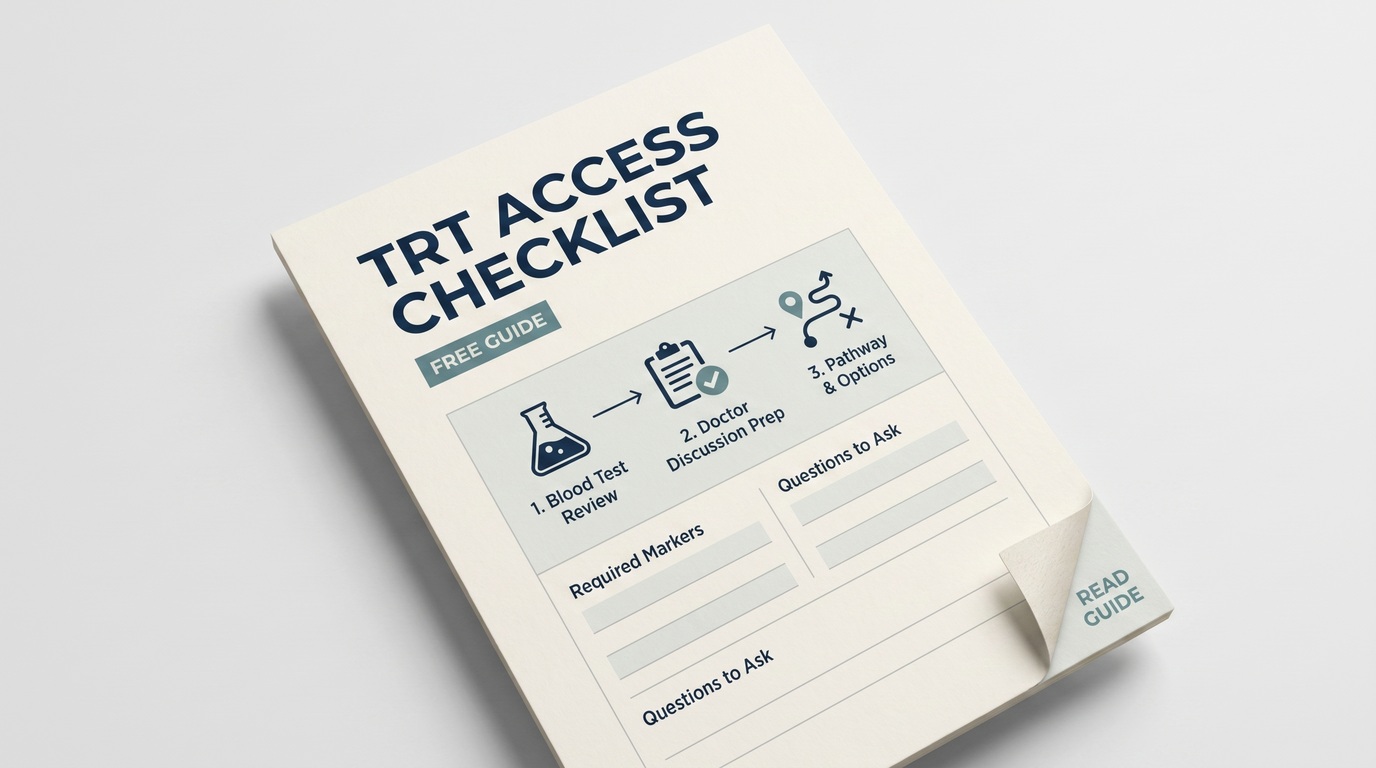
Legal Testosterone Online Australia: The 2026 Guide to Safe TRT
What this should help you decide
- Use this to decide which symptoms, markers, or history points are worth raising with a clinician.
- Pay attention to the concrete markers mentioned here: testosterone, shbg, peptide, blood work.
- The practical parts are: The Hard Truth About 'Legal Online' Testosterone in 2026; Understanding Schedule 4 vs Schedule 8: The Critical Distinction; The Three Legitimate Pathways to TRT in Australia.
- Do not treat the article as a dosing plan or a suitability decision.
These are the concrete topics this article touches. If a piece cannot produce this list, it is probably too vague.
Legal Testosterone Online Australia: The 2026 Guide to Safe TRT
Last Updated: April 2026
Here's the hard truth: If you're searching for "legal testosterone online Australia" in 2026, you're likely navigating a minefield of misleading claims. While TRT is absolutely legal when prescribed by a licensed Australian healthcare professional, the "online" component introduces regulatory complexities that most clinics gloss over.
The $70-200/month price points you see across the internet are dangerously outdated. In 2026, legitimate private TRT through Australian telehealth clinics runs $200-500/month depending on delivery method, pathology requirements, and whether you're using compounded preparations versus PBS-listed options.
But here's what separates Varney Health from generic TRT providers: We don't just hand out testosterone. We integrate hormone optimisation with peptide therapy, ensuring you're treating the root cause of androgen deficiency, not just masking symptoms with a Schedule 4 substance.
The Hard Truth About 'Legal Online' Testosterone in 2026
Let's dispel a myth immediately: There is no such thing as "over-the-counter" testosterone in Australia. Despite what grey-market supplement sites claim, testosterone remains a Schedule 4 (Prescription Only) substance under the Poisons Standard 2026. This means:
- Prescription Required: A valid prescription from an Australian-registered medical practitioner is mandatory
- Pathology Gatekeeping: You must demonstrate clinically low levels (Free T <14 pmol/L or Total T <12 nmol/L per 2026 guidelines) PLUS symptoms
- Geographic Restrictions: The prescribing doctor must be registered with the Medical Board of Australia and able to prescribe in your state/territory
What competitors don't tell you: Many "online TRT" services are actually operating in a regulatory grey zone. They may be using "wellness" language to skirt the line between legitimate hormone therapy and unregulated hormone optimisation. The difference matters when you're dealing with substances that can shut down your HPTA axis permanently.
Understanding Schedule 4 vs Schedule 8: The Critical Distinction
This is the information gap that gets men into trouble with Australian Border Force (ABF). While testosterone itself is Schedule 4 (Prescription Only), many "testosterone boosters" and precursor compounds fall under Schedule 8 (Controlled Drugs) or Schedule 9 (Prohibited).
In 2026, the ABF has tightened enforcement on:
- 17-alpha-alkylated derivatives: Oral testosterone compounds (methyltestosterone, etc.) are Schedule 8 and require additional import permits
- Prohormones: Compounds like androstenedione or 19-norandrostenedione are Schedule 9—illegal to import without a Commonwealth Minister's exemption
- Uncompounded injectables: Bulk testosterone cypionate/propionate purchased from overseas without an Australian prescription faces immediate seizure
Practitioner Insight: At Varney Health, we've seen patients unknowingly import Schedule 8 compounds believing they were "legal" because they had a prescription. The reality: Schedule 8 substances require additional import permits beyond a standard prescription. Always verify your substance's schedule with the TGA before ordering online.
The Three Legitimate Pathways to TRT in Australia
In 2026, there are exactly three legal ways to access testosterone replacement therapy:
1. PBS-Subsidised Pathway (GP-Based)
Available through general practitioners, this remains the cheapest option at $30-40/month for concession card holders or $30-70/month for general patients. However, PBS criteria are stringent:
- Diagnosed hypogonadism (not just "low T" feelings)
- Two separate morning blood tests showing clinically low levels
- Exclusion of reversible causes (sleep apnoea, obesity, medications)
- Typically limited to standard PBS-listed preparations (testosterone undecanoate injections)
The Catch: PBS TRT doesn't cover customised dosing or compound formulations. You're limited to standard 1g every 10-14 weeks injections or 1% gel preparations.
2. Private Telehealth (The "Online" Route)
This is where most "legal testosterone online Australia" searches lead. Legitimate private telehealth clinics (like Apex TRT, Enhanced Men's Clinic, or Varney Health) operate under the following 2026 framework:
- Telehealth prescribing: Valid across all Australian states/territories (post-2025 Permanent Telehealth Regulations)
- Pathology integration: Direct-to-consumer pathology (e.g., iMedical, Sonic Healthcare) with digital result sharing
- Pharmacy partnerships: Compounding pharmacies (e.g., HPA, The Chemist Warehouse compounding services) for customised formulations
- Cost: $150-400/month (consultation + medication + pathology)
What this means: When you see "TRT online Australia" services advertising $99/month, they're either cutting corners on pathology (not doing SHBG or prolactin checks) or using substandard compounding facilities.
3. Private Specialist Clinics (In-Person)
Endocrinologists or urologists in private practice. Most expensive at $300-600/month but offers the most comprehensive care including fertility preservation strategies.
Australian Border Force Rules: What You Can (and Can't) Import
This is the section competitors skip entirely. If you're considering ordering testosterone from overseas suppliers ("grey market" TRT), understand the 2026 ABF position:
Legal Imports (with prescription):
- Personal use quantities (up to 3 months supply) of Schedule 4 substances
- Must be declared upon arrival
- Prescription must be in your name and issued by an Australian medical practitioner
- Commercial quantities (even with prescription) require import permits
Illegal Imports (immediate seizure/confiscation):
- Any Schedule 8 substances (oral testosterone, certain anabolic steroids)
- "Research chemical" testosterone analogues (Trenbolone, Drostanolone, etc.)
- Quantities exceeding 3 months personal use
- Substances purchased from unlicensed overseas pharmacies
Case Study: In late 2025, ABF seized $2.3 million worth of "legal" testosterone purchased by Australian men from overseas "telehealth" services. These services operated outside Australian jurisdiction, meaning their "prescriptions" held no legal weight under Australian law.
2026 Pricing Reality: What You Actually Pay
Let's cut through the $70/month marketing claims. Here's the actual 2026 cost breakdown for legitimate TRT:
| Component | 2026 Cost | Notes |
|---|---|---|
| Initial Consultation | $150-300 | Telehealth or in-person |
| Pathology Panel | $200-450 | Free T, Total T, SHBG, CBC, Lipids, Prolactin, PSA, Liver/Kidney function |
| Testosterone (Monthly) | $100-300 | Gel: $150-250; Injections: $80-150; Compounded: $200-400 |
| Follow-up Pathology | $150-250 | Every 3-6 months |
Why the price gap? Legitimate clinics include ongoing pathology monitoring, which is non-negotiable for safety. Testosterone therapy requires monitoring of:
- Hematocrit: Risk of polycythaemia (blood thickening)
- Lipid profile: Potential cardiovascular impacts
- PSA: Prostate health monitoring
- SHBG: Free vs bound testosterone ratios
Practitioner Insight: If a clinic offers TRT without ongoing pathology, they're not practising evidence-based medicine. In 2026, we've seen cases of undiagnosed polycythaemia leading to thrombotic events in men on cheap "online TRT" without monitoring.
Beyond Replacement: The Peptide & Biohacking Integration
Here's where Varney Health diverges from standard TRT clinics. Testosterone replacement treats the symptom (low T), but doesn't necessarily address the optimisation of your hormonal ecosystem. In 2026, advanced biohacking integrates:
TRT + Peptide Therapy
Combining testosterone with peptides like:
- BPC-157: Gut health and injury recovery
- Epitalon: Telomere lengthening and sleep optimisation
- Ipamorelin/CJC-1295: HGH optimisation without the side effects of exogenous GH
TRT + Fertility Preservation
Traditional TRT shuts down spermatogenesis. Modern 2026 protocols include:
- hCG integration: Maintaining testicular size and fertility potential
- Clomiphene Citrate: For men desiring future fertility
TRT + Lifestyle Optimisation
Hormone therapy isn't a magic bullet. It works best with:
- Optimised sleep (7-9 hours for T production)
- Resistance training (stimulates T receptor sensitivity)
- Vitamin D3 optimisation (critical for T synthesis)
Red Flags: When 'Legal' Becomes Illegal
Before you purchase "legal testosterone online Australia," check for these warning signs:
- No Pathology Required: If they prescribe without blood work, they're not following Australian medical standards
- "Guaranteed" Results: Medical treatment doesn't guarantee outcomes; it offers probability
- Payment via Crypto Only: Legitimate medical services accept standard payment methods
- No Australian ABN: Verify the clinic has an Australian Business Number
- "Wellness" Language: Be wary of clinics using "wellness optimisation" to avoid medical regulation
Frequently Asked Questions
Is testosterone therapy legal in Australia?
Yes, but only when prescribed by an Australian-registered medical practitioner for legitimate medical indications (clinically low testosterone with symptoms). It remains a Schedule 4 substance under the Poisons Standard 2026.
Is it legal to bring testosterone into Australia?
Only under strict conditions: (1) You have a valid Australian prescription, (2) It's for personal use (up to 3 months supply), (3) It's declared to customs, and (4) It's not a Schedule 8 substance (oral testosterone derivatives). Failure to comply can result in seizure and potential criminal charges.
Why is TRT so hard to get in Australia?
Three factors: (1) Stringent TGA regulations requiring pathology confirmation, (2) Limited PBS-listed options (mostly injections), and (3) Compounding pharmacy requirements for customised formulations. This protects patients but creates access barriers compared to less regulated jurisdictions.
Are there legal testosterone supplements?
No. True testosterone is prescription-only. "Testosterone boosters" are marketing terms for supplements (ZMA, Vitamin D, Ashwagandha) that may support natural production but cannot replace clinical TRT. Be wary of supplements claiming to "boost T"—they're typically Schedule 9 prohibited substances in disguise.
Can I get TRT through online telehealth in Australia?
Yes. Since the 2025 Permanent Telehealth Regulations, Australian-registered doctors can prescribe Schedule 4 substances via telehealth across state borders. However, the prescription must be dispensed by an Australian pharmacy.
What's the difference between TRT and testosterone "optimisation"?
TRT (Testosterone Replacement Therapy) treats diagnosed deficiency (hypogonadism). "Optimisation" or "biohacking" often refers to pushing levels above physiological normal for performance enhancement—this carries higher health risks and may violate sports anti-doping regulations.
How much does TRT cost in Australia (2026)?
PBS: $30-70/month. Private telehealth: $150-400/month (including pathology). Private specialist: $300-600/month. Online "grey market" imports: Risk of seizure, legal consequences, and health risks from unverified substances.
Disclaimer: This article is for informational purposes only and does not constitute medical advice. Testosterone is a prescription-only medication. Consult with a qualified Australian healthcare professional before considering hormone therapy. Always verify regulatory status with the Australian Border Force and TGA before importing medications.
Questions to ask before acting on this
Use this as a filter before you bookmark, share, or act on the article.
- 1
What symptom, lab marker, or risk does this change?
- 2
Which baseline tests should be checked before any treatment decision?
- 3
What would make this unsuitable for me?
- 4
What follow-up or monitoring would a clinician expect?
The caveat that keeps this useful
Treatment choices need a clinician who can see your history, medication use, blood work, and risk factors. A blog post should help you ask better questions, not self-prescribe.
Want this reviewed properly?
Use the assessment to give the clinic context before a doctor reviews suitability. It does not replace clinical advice.