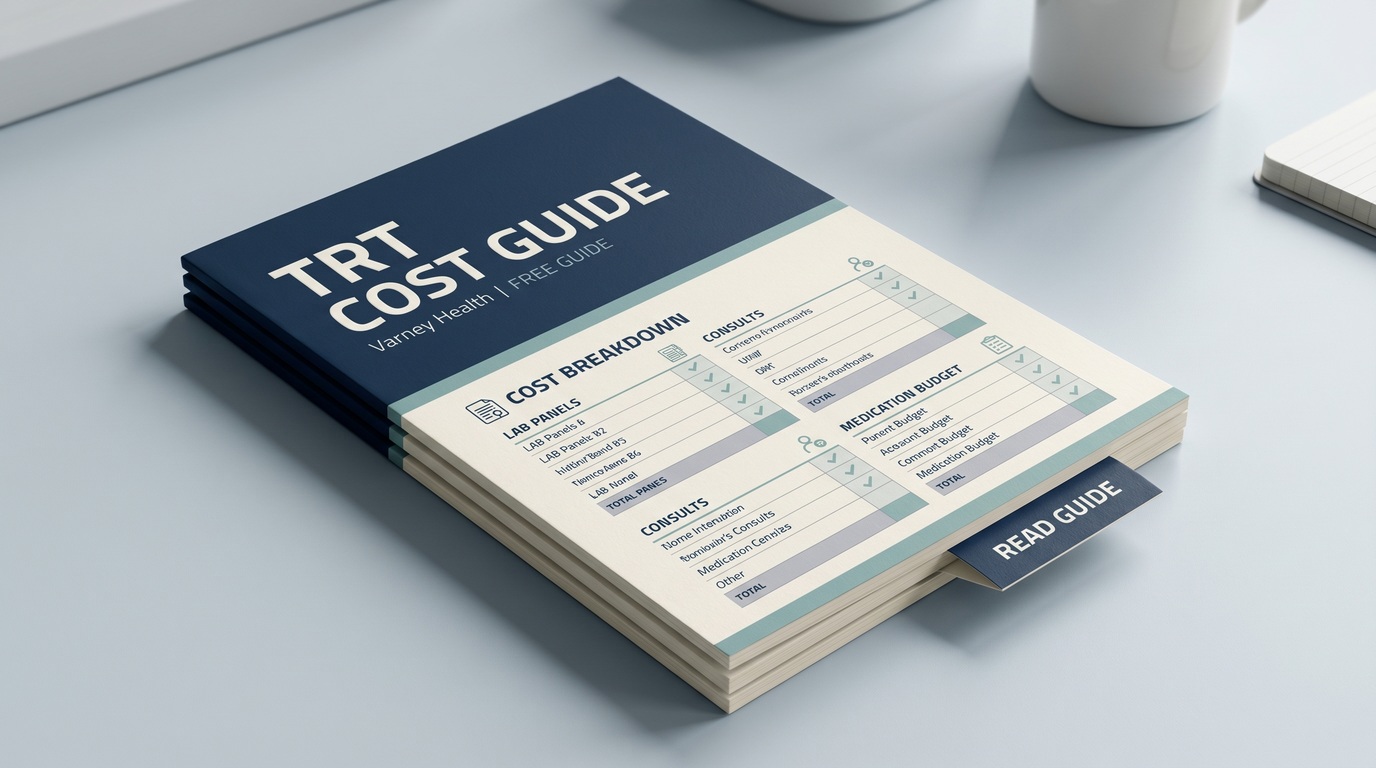
Testosterone Prescription Cost Australia 2026: Complete Breakdown
What this should help you decide
- Use this to decide which symptoms, markers, or history points are worth raising with a clinician.
- Pay attention to the concrete markers mentioned here: testosterone, free testosterone, estradiol, shbg.
- The practical parts are: The 2026 Reality Check: Why TRT Pricing is Finally Transparent; Upfront Costs: Consultations & Pathology (2026 Prices); Treatment Modality Cost Breakdown: Injections vs Gels vs Patches vs Pellets.
- Do not treat the article as a dosing plan or a suitability decision.
These are the concrete topics this article touches. If a piece cannot produce this list, it is probably too vague.
Testosterone Prescription Cost Australia 2026: Complete Breakdown
Direct Answer: In 2026, the average Australian man pays $800-$1,500 in the first year for TRT, with ongoing costs of $300-$800 annually depending on treatment modality. Telehealth clinics offer the most cost-effective entry at $349-$500 for initial assessment, while PBS-subsidised gels cost $30-$35 per month after subsidy. Private injections range from $60-$150 monthly. Last Updated: April 2026
The TRT landscape in Australia has undergone a seismic shift in 2026. What was once a fragmented, opaque pricing structure has crystallised into a transparent ecosystem where men can predict their costs with precision. However, the devil remains in the details—specifically, the hidden fees, state-based pathology variations, and long-term commitment costs that generic guides from 2024-2025 completely miss.
The 2026 Reality Check: Why TRT Pricing is Finally Transparent
As of 2026, the Royal Australian College of General Practitioners (RACGP) updated their men's health guidelines to include mandatory cost disclosure requirements for hormone therapy clinics. This means what you see is what you pay—no more $49 blood tests that require $300 consultations before you can discuss results.
But transparency doesn't mean uniformity. The testosterone prescription cost Australia varies dramatically based on your pathway: public GP referral, private telehealth clinic, or specialist endocrinologist. Understanding these three tiers is crucial for your 2026 budget planning.
Upfront Costs: Consultations & Pathology (2026 Prices)
Initial Consultations (2026 Pricing):
- GP Consultation: $50-$150 (bulk-billed if Medicare eligible, otherwise private fee). In 2026, most GPs require a separate pathology requisition visit ($80-$120) before discussing TRT.
- Telehealth Specialist (Men's Health): $300-$450 for comprehensive initial assessment including symptom review, lifestyle analysis, and pathology requisition.
- Endocrinologist Specialist: $250-$400 for initial consultation, requiring GP referral (though Medicare rebate applies, out-of-pocket remains $150-$250).
Pathology Costs (Comprehensive Hormone Panel 2026):
The 2026 standard for testosterone diagnosis requires more than just total testosterone. The complete panel includes:
- Total Testosterone
- Free Testosterone
- SHBG (Sex Hormone Binding Globulin)
- LH/FSH (pituitary function markers)
- PSA (Prostate Specific Antigen)
- Haemoglobin/Haematocrit (blood thickness markers)
- Estradiol (E2)
- Complete Blood Count & Kidney/Liver Function
Cost breakdown:
- Private Pathology (PathologyWorks, Sonic Healthcare, Healthscope): $180-$280 for comprehensive panel
- Public Pathology: $0-$50 with Medicare referral (but wait times 4-8 weeks in 2026)
- Telehealth Clinic Pathology: Often bundled at $120-$150 with clinic partnership discounts
Treatment Modality Cost Breakdown: Injections vs Gels vs Patches vs Pellets
This is where most guides fail. They lump "TRT" together, but the cost variance between modalities is massive in 2026.
1. Injectable Testosterone (Most Cost-Effective)
PBS-Subsidised Options (2026):
- Testoviron Depot (Testosterone Enanthate): $30-$35 per month (PBS co-payment for pensioners/concession card holders: $7.60)
- Generic Testosterone Cypionate: $40-$60 per month (private prescription, pharmacy compounded)
Private Compounded Injections (Telehealth Clinics):
- Standard Dose (250mg/week): $80-$120 per month
- High-Dose/Bio-identical Blends: $120-$180 per month
- Shipping & Handling: $15-$25 per delivery (often free with annual subscription)
Practitioner Insight: In 2026, compounded injections are increasingly popular due to the 2025 Therapeutic Goods Administration (TGA) update allowing longer-acting ester blends (cypionate + enanthate combinations) for stable blood levels.
2. Topical Gels (Most Convenient, Highest Cost)
PBS Options:
- Testogel 1%: $79.29 per month, PBS co-payment $30-$35 (concession: $7.60)
- AndroGel 1%: Private prescription only, $120-$150 per month
Non-PBS Gels (Private):
- AndroGel: $120-$150/month
- Generic 1% Gel: $80-$100/month
Hidden Cost Alert: Gel users often require 2-3 tubes monthly. At $30-$35 per tube (PBS), that's $90-$105/month, not the single $30-$35 figure often advertised.
3. Patches (Least Common, Moderate Cost)
- Androderm: $200-$280 per month (28 patches)
- Reapplication patches: Additional $20-$40 per week
4. Testosterone Pellets (Longest-Lasting, Highest Upfront)
- Insertion Procedure: $800-$1,200 (includes pellets, procedure, follow-up)
- Pellet Cost: $300-$500 per 4-6 month supply
- Effective Monthly: $50-$100/month when annualised
Hidden Costs Most Clinics Won't Tell You
Here's what the $49 blood test clinics don't mention:
- Follow-Up Pathology: TRT requires monitoring every 3 months for the first year, then every 6 months. At $80-$150 per comprehensive panel, that's $320-$600 annually in hidden pathology costs not included in "monthly medication fees".
- Medication Titration: First 3 months often require dose adjustments. Many clinics charge $150-$200 per follow-up consult when adjusting from 250mg to 350mg, or switching from enanthate to cypionate.
- Shipping & Storage: Injectable testosterone requires refrigeration (2-8°C). Shipping via Australia Post Express Post costs $15-$25 per delivery. If you're in remote QLD or WA, this can be $40-$60 per shipment.
- Syringe/Needle Costs: Most clinics don't include these. Expect $30-$50 per box of 50 syringes, plus needles ($20-$30 per box of 100).
- Annual GP Check: Even with telehealth, you need an annual GP check for ECG/blood pressure monitoring. $50-$150 annually.
State-by-State Variations: NSW vs VIC vs QLD Pricing
2026 pathology pricing varies by state due to different bulk-billing rates and pathology provider competition:
| State | Pathology Panel Cost | GP Consult Avg | Pharmacy Markup |
|---|---|---|---|
| NSW | $180-$220 | $80-$120 | Standard |
| VIC | $160-$200 | $70-$110 | Lower (more competition) |
| QLD | $170-$210 | $75-$115 | Standard + shipping fees for remote |
| WA | $190-$240 | $85-$130 | +15% for remote areas |
| SA/TAS | $170-$200 | $70-$100 | Standard |
Practitioner Insight: Pathology costs in 2026 are driven by Sonic Healthcare and Healthscope market dominance. In VIC, PathologyWorks offers more competitive pricing ($160-$180 for full panels) compared to NSW ($200+).
Long-Term Cost Projections: 1, 5, and 10-Year Treatment Plans
Most men don't calculate the 10-year view. Here's the 2026 reality:
Year 1 (Setup & Titration)
- Initial consult: $300-$450
- Pathology (4x comprehensive): $640-$960
- Medication (injectable): $960-$1,440
- Follow-up consults (3x): $450-$600
- Total Year 1: $2,350-$3,450
Years 2-5 (Stable Dose)
- Pathology (2x annually): $320-$480
- Medication: $960-$1,440
- Consults (2x annually): $300-$450
- Annual: $1,580-$2,370
10-Year Projection (Injectable TRT)
- Total Cost: $15,000-$25,000 (including inflation adjustments for 2026-2036)
- Monthly Average: $125-$210
Public vs Private Pathway: Detailed Cost Comparison
Public Pathway (2026):
- GP bulk-billed consult: $0
- GP referral to public endocrinologist: $0 (but 6-12 month wait in 2026)
- Public pathology: $0-$50
- PBS medication: $30-$35/month (gel) or $30/month (injection)
- Total Year 1: $360-$420 (but 12-18 months to start treatment)
Private Telehealth Pathway (2026):
- Initial consult + pathology: $300-$500
- Medication: $60-$120/month
- Follow-ups: $150-$200 per consult (quarterly)
- Total Year 1: $1,800-$2,500 (treatment starts within 2-4 weeks)
Payment Options & Insurance Rebates in 2026
Private Health Insurance Rebates
With 2026's updated extras cover policies:
- Pathology: 20-30% rebate on comprehensive panels ($40-$80 back)
- GP Consults: 50-70% rebate ($40-$80 back)
- Specialist Consults: 20-40% rebate ($60-$120 back)
Payment Plans (2026 Options)
- Afterpay/Zip: Available at 40% of telehealth clinics for amounts over $200
- Clinic Payment Plans: Some offer 12-month interest-free plans for annual subscriptions ($2,400+ treatments)
- Medicare Rebates: $61-$150 per specialist consult, $30-$60 per GP consult (depending on bulk-billing status)
Tax Implications (2026 GST Rules)
Private consultations are GST-inclusive (10%). PBS medications are GST-free. Private compounded injections may or may not include GST depending on pharmacy—always ask if the price is "plus GST" or "GST inclusive".
Frequently Asked Questions (2026 Update)
Why is TRT so hard to get in Australia?
As of 2026, the RACGP maintains strict diagnostic criteria: two separate blood tests showing low testosterone (<10.4 nmol/L) plus symptoms. The 2025 PBS restrictions on gel formulations (requiring specialist prescription for non-PBS brands) have also created bottlenecks. However, telehealth clinics have streamlined this with rapid pathology turnaround.
Can taking testosterone raise your PSA?
Yes, but not dangerously. Testosterone can increase PSA levels by 0.1-0.3 ng/mL, which is within normal variation. In 2026, guidelines recommend baseline PSA before starting TRT, then monitoring every 6-12 months. Levels above 4.0 ng/mL require urology referral regardless of TRT status.
Is testosterone covered under PBS?
Yes, but selectively. In 2026, PBS covers Testoviron Depot (injection) and Testogel 1% (gel) for men with documented hypogonadism. AndroGel and compounded injections are private prescriptions. PBS co-payment is $30-$35 for general patients, $7.60 for concession card holders.
Is it worth it to start testosterone FTM (FTM hormone therapy)?
This question refers to transgender men (FTM) seeking testosterone for gender affirmation. In 2026, FTM hormone therapy costs differ: initial consults $300-$400, ongoing pathology $80-$150 per test, and medication $50-$100/month. Many state health departments offer FTM-specific pathways with reduced costs ($0-$100/month).
What's the cheapest way to start TRT in Australia 2026?
The absolute cheapest route is the public pathway: bulk-billed GP → public referral → PBS Testoviron Depot. Total cost: $30-$35/month. However, this takes 6-12 months. The cheapest private route is telehealth with injectable TRT: ~$150-$200/month including consults and pathology.
Do I need to see a specialist or can a GP prescribe?
Both can prescribe in 2026. However, GPs must refer to specialists for PBS-subsidised gel therapy. For injectables, GPs can prescribe, but many prefer specialist oversight for first-year titration. Telehealth clinics bridge this gap with GP-endorsed protocols.
How often do I need blood tests?
2026 Guidelines: Every 3 months for first year (4 tests), every 6 months thereafter (2 tests). Comprehensive panels cost $80-$150 each. Some clinics bundle annual pathology ($300-$500) to reduce per-test costs.
Conclusion: The 2026 TRT Investment
Testosterone prescription costs in Australia have stabilised in 2026, with transparent pricing across telehealth and private pathways. While upfront costs range from $300-$500 for initial assessment, the ongoing monthly investment of $100-$200 for injectable TRT represents a cost-effective health optimisation strategy when compared to the productivity, health, and longevity benefits.
The key is understanding the full cost structure: upfront consultations, monthly medication, quarterly pathology, and annual follow-ups. With the 2026 transparency requirements, you can now budget precisely for your TRT journey—no more surprise $300 consults after $49 blood tests.
Disclaimer: This article reflects 2026 Australian healthcare pricing and regulations. Individual costs vary based on location, insurance, and clinical needs. Always consult a qualified healthcare provider before starting hormone therapy.
Questions to ask before acting on this
Use this as a filter before you bookmark, share, or act on the article.
- 1
What symptom, lab marker, or risk does this change?
- 2
Which baseline tests should be checked before any treatment decision?
- 3
What would make this unsuitable for me?
- 4
What follow-up or monitoring would a clinician expect?
The caveat that keeps this useful
Treatment choices need a clinician who can see your history, medication use, blood work, and risk factors. A blog post should help you ask better questions, not self-prescribe.
Want this reviewed properly?
Use the assessment to give the clinic context before a doctor reviews suitability. It does not replace clinical advice.