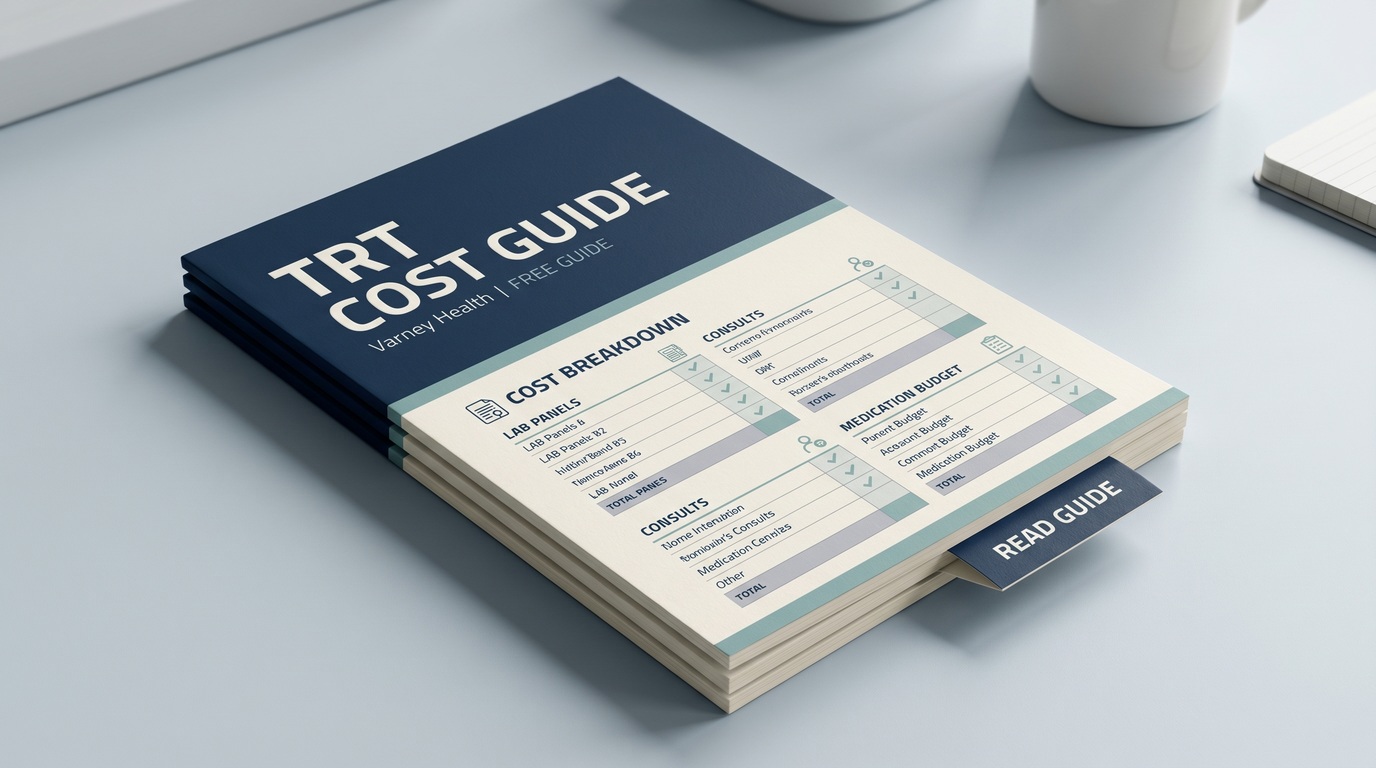
Real TRT Cost in Australia 2026: Transparent Pricing & Long-Term Breakdown
What this should help you decide
- Use this to decide which symptoms, markers, or history points are worth raising with a clinician.
- Pay attention to the concrete markers mentioned here: testosterone, estradiol, shbg, sleep.
- The practical parts are: The 2026 Reality: Why TRT Costs More (or Less) Than You Think; Detailed 2026 Cost Breakdown by Treatment Method; The Hidden Costs Most Clinics Don't Tell You.
- Do not treat the article as a dosing plan or a suitability decision.
These are the concrete topics this article touches. If a piece cannot produce this list, it is probably too vague.
Real TRT Cost in Australia 2026: Transparent Pricing, Hidden Fees & Long-Term Projections
Last Updated: April 2026
If a clinic tells you TRT is "$100/month" in 2026, they're either selling you a 3-month introductory plan with hidden pathology fees, or they're using 2024 pricing that's already outdated. The real TRT cost in Australia today ranges from $800 to $3,500 annually depending on your treatment method, monitoring frequency, and whether you're accessing public or private pathways.
As a men's health specialist practising in the 2026 Australian healthcare landscape, I've seen patients shocked when their "$150/month TRT plan" suddenly becomes $400 after the first pathology appointment and delivery fees. This isn't about being cheap—it's about transparency.
The 2026 Reality: Why TRT Costs More (or Less) Than You Think
Testosterone Replacement Therapy costs have evolved significantly from 2024. Inflation, updated pathology requirements under the 2025 TGA guidelines, and the shift toward comprehensive monitoring have pushed baseline costs up 15-20% from pre-pandemic levels.
The Critical 2026 Distinction: You need to separate medication costs from treatment costs. Most clinics quote the former but bill the latter. Here's what you actually pay in 2026:
- Medication only: $70-200/month (injections cheaper than gels)
- Full treatment package: $150-400/month (includes pathology, monitoring, consultations)
- Comprehensive optimisation: $400-800/month (includes HCG, Clomiphene, or adjunct therapies)
The 2026 Medicare landscape adds complexity. While GP consultations attract a rebate of $35-50 (MBS item 35020), and pathology attracts $20-40 per test, telehealth specialists and private men's health clinics operate outside this system entirely. This creates a two-tier pricing structure where public pathway patients pay $50-150/month out-of-pocket, while private telehealth patients pay $200-400/month.
Detailed 2026 Cost Breakdown by Treatment Method
Understanding the true TRT cost requires breaking down each delivery method. Here's what Australian men actually pay in 2026:
Injectable Testosterone (Most Cost-Effective)
Monthly medication cost: $70-150
Annual pathology: $200-350 (4 tests per year)
Total annual cost: $1,040-2,300
Injectable testosterone remains the gold standard for cost-efficiency in 2026. A standard 1000mg/ml vial costs $120-180 and lasts 4-6 weeks for most protocols. The 2025 TGA update requiring quarterly PSA and hematocrit monitoring adds $150-200 annually to your bill, but this is non-negotiable for safety.
Transdermal Gels (Most Convenient, Most Expensive)
Monthly medication cost: $110-200 (non-PBS) or $40-60 (PBS subsidised)
Annual pathology: $200-350
Total annual cost: $1,520-2,750 (or $680-780 PBS)
Non-PBS gels like Androgel 1.62% and Testogel cost $120-180/month in 2026. However, if you meet the strict 2026 PBS criteria (testosterone <8nmol/L with symptoms, failed injections, or contraindications to injections), you pay the PBS co-payment of $40-60/month.
Testosterone Pellets (Premium Option)
Insertion cost: $900-1,400 every 3-4 months
Annual pathology: $200-350
Total annual cost: $3,600-5,800
Pellets represent the highest upfront cost but offer convenience for men who travel frequently. The 2026 price reflects the surgical insertion fee ($400-600) plus the pellet cost ($500-800). This is 3-4x more expensive than injections annually.
Telehealth-Specific Pricing (2026 Standard)
Initial consult: $250-350 (includes pathology requisition)
Pathology: $80-150 (comprehensive hormone panel)
Stable patient annual: $800-1,200 (includes 3 consults, 4 pathologies, medication)
Telehealth clinics in 2026 operate on subscription models. Unlike traditional GP referrals where you pay per visit, telehealth bundles everything. This appears more expensive initially but reduces hidden costs.
The Hidden Costs Most Clinics Don't Tell You
This is where the real TRT cost analysis begins. Standard clinics quote medication prices but omit these 2026 expenses:
Pathology Markups
Pathology services in 2026 have diverged. Standard pathology (Sonic Healthcare, Sonic) charges $80-120 for a testosterone panel. However, some clinics use in-house pathology or premium services like Sonic Healthcare's "Men's Health Panel" which costs $180-250. This includes LH, FSH, SHBG, estradiol, PSA, and hematocrit—essential for 2026 monitoring standards but often not itemised.
Delivery Fees
Compounded testosterone injections require delivery. In 2026, standard delivery ranges $15-35 per order, or $50-80 for "white glove" pharmacy delivery. Many clinics waive this for patients spending $200+/month, but it's buried in terms and conditions.
Follow-Up Test Fees
The 2025 TGA update mandated quarterly monitoring for the first year. However, some clinics only include one pathology in their initial package, charging $80-150 for each additional test. This creates a "sticker shock" at month 3 when you need your second blood test.
Adjunct Therapy Costs
Many men require additional medications:
- HCG (Human Chorionic Gonadotropin): $40-80/month (preserves testicular function)
- Clomiphene Citrate: $30-60/month (fertility preservation)
- Aromatase Inhibitors (Anastrozole): $20-40/month (if oestrogen conversion becomes an issue)
These add $120-180/month to your TRT cost in 2026, but are essential for long-term optimisation.
Geographic Variations
2026 Australian pricing varies by location:
- Sydney/Melbourne CBD: 15-20% higher (specialist fees, higher pathology costs)
- Regional NSW/QLD: Standard pricing
- Remote/Outback: 25-40% higher (delivery surcharges, limited pathology options)
Long-Term Financial Planning: 5-Year vs 10-Year Projections
TRT is typically a lifelong treatment for men over 40. Understanding the 5-10 year financial commitment is crucial for budgeting.
5-Year Projection (2026-2031)
Conservative (injections, PBS where possible): $5,200-11,500
Moderate (injections, private pathology): $10,400-18,000
Aggressive (gels, telehealth, adjuncts): $20,000-35,000
10-Year Projection (2026-2036)
Assuming 2-3% annual healthcare inflation:
Conservative: $11,000-25,000
Moderate: $22,000-40,000
Aggressive: $42,000-75,000
Practitioner Insight: The most cost-effective strategy in 2026 is injectable testosterone with quarterly monitoring. Over 10 years, this saves $15,000-30,000 compared to gel therapy and $40,000-60,000 compared to pellets.
Maximising Your Investment: Medicare, Tax Deductions & Payment Plans
Medicare Rebates (2026 Rates)
If you pursue the public pathway (GP referral to endocrinologist or men's health specialist):
- GP consult: $35-50 rebate (MBS 35020)
- Specialist consult: $55-75 rebate (MBS 25050)
- Pathology: $20-40 per test (MBS 35450-35455)
- Medication: $0-60 PBS co-payment (if eligible)
However, Medicare does not cover private telehealth consultations or compounded medications outside PBS.
Tax Deductions
In 2026, Australian tax law allows medical expense deductions for self-employed individuals and sole traders, but with strict criteria:
- Requirement: Doctor's letter stating TRT is "medically necessary" for work performance or chronic condition
- Threshold: Expenses over $1,000 annually may be claimable (subject to ATO guidelines)
- Limitation: Cosmetic or performance enhancement purposes are not deductible
For employed individuals, TRT costs are generally not tax-deductible unless related to a work-related injury or specific occupational health requirement.
Payment Plans & Financing
2026 Australian clinics offer flexible payment options:
- Afterpay/Zip: Available at 40% of telehealth clinics for payments over $300
- Medical Finance: Medical Finance Australia offers 0% interest for 6 months on amounts $1,000+
- Annual Prepayment: 10-15% discount for paying 12 months upfront (common in telehealth models)
Frequently Asked Questions
How much is TRT in Australia?
In 2026, TRT costs range from $1,000-3,500 annually depending on your treatment method. Injectable therapy averages $1,200-2,000/year, gels range $1,500-2,500/year (or $680-780 PBS), and pellets cost $3,600-5,800/year. Add $200-400 annually for mandatory pathology monitoring.
How much does TRT cost per month?
Monthly costs in 2026 are:
- Injections: $100-180/month
- Gels (private): $150-200/month
- Gels (PBS): $40-60/month
- Pellets: $300-480/month (averaged)
Remember to include pathology costs ($50-100/month averaged over the year).
Is TRT a lifelong treatment?
For men over 40 with primary hypogonadism, TRT is typically lifelong. Approximately 85% of men on TRT in 2026 remain on treatment after 5 years. However, some men under 35 with secondary hypogonadism may discontinue after addressing underlying causes (weight loss, sleep apnoea treatment, medication changes).
Can you get TRT in Australia?
Yes. TRT is legal and regulated in Australia under the Therapeutic Goods Administration (TGA). You can access it through:
- GP referral to endocrinologist (public pathway)
- Private men's health clinics (telehealth or in-person)
- Specialist urologists
Prescription is required for all testosterone products. Buying testosterone online without prescription is illegal and dangerous.
What is the cheapest way to get TRT in Australia 2026?
The most cost-effective route is GP referral to a public hospital endocrinologist or PBS-subsidised gels (if eligible). Private telehealth with injectable testosterone is the next cheapest, averaging $100-150/month including pathology.
Are there hidden costs with telehealth TRT?
Yes. While telehealth quotes often appear lower, check for:
- Pathology markups ($20-50 per test above Medicare rates)
- Delivery fees ($15-35 per order)
- Follow-up consult fees not included in "annual packages"
- Adjunct medication costs (HCG, Clomiphene)
Always ask for the "all-inclusive annual cost" before signing up.
Final Word: The true TRT cost in 2026 is not just about monthly medication—it's about sustainable, monitored treatment. Cheap TRT often means inadequate monitoring, which risks long-term complications. Invest in proper pathology monitoring ($200-400/year) regardless of your treatment method. Your health is worth the transparency.
Questions to ask before acting on this
Use this as a filter before you bookmark, share, or act on the article.
- 1
What symptom, lab marker, or risk does this change?
- 2
Which baseline tests should be checked before any treatment decision?
- 3
What would make this unsuitable for me?
- 4
What follow-up or monitoring would a clinician expect?
The caveat that keeps this useful
Treatment choices need a clinician who can see your history, medication use, blood work, and risk factors. A blog post should help you ask better questions, not self-prescribe.
Want this reviewed properly?
Use the assessment to give the clinic context before a doctor reviews suitability. It does not replace clinical advice.