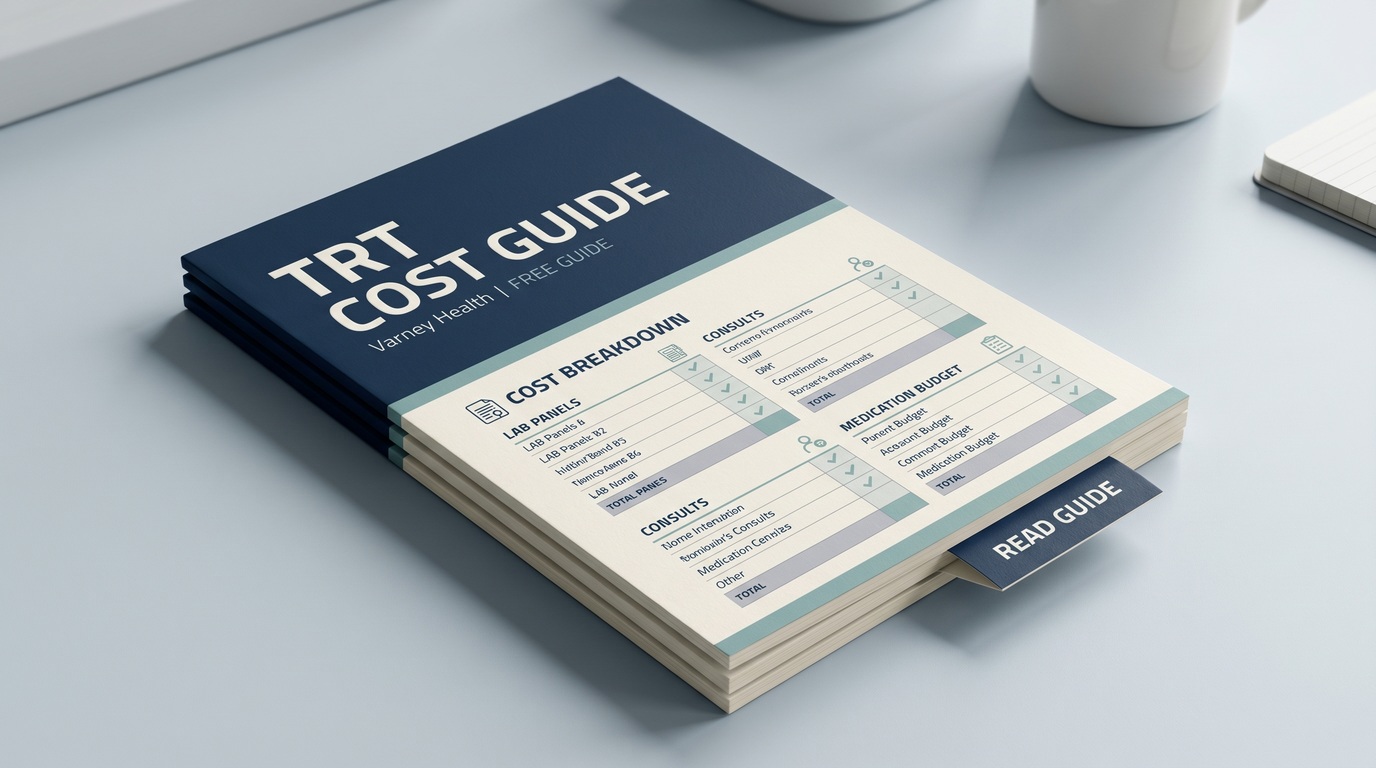
How Much Does TRT Cost Australia 2026? Complete Pricing Guide
What this should help you decide
- Use this to decide which symptoms, markers, or history points are worth raising with a clinician.
- Pay attention to the concrete markers mentioned here: testosterone, estradiol, shbg, thyroid.
- The practical parts are: The 2026 TRT Cost Breakdown: What You'll Actually Pay; 8 Cost Factors That Determine Your TRT Bill; Telehealth vs In-Person: 2026 Price Comparison.
- Do not treat the article as a dosing plan or a suitability decision.
These are the concrete topics this article touches. If a piece cannot produce this list, it is probably too vague.
How Much Does TRT Cost Australia 2026? Complete Pricing Guide
Quick Answer: In 2026, TRT (Testosterone Replacement Therapy) in Australia costs between $200–$1,500 for initial diagnosis and setup, with ongoing monthly costs ranging from $150–$400 depending on your treatment method. Telehealth options dominate the 2026 market, with comprehensive care plans averaging $300–$450 monthly including pathology and e-prescriptions.
Last Updated: April 2026
If you're reading this in 2026, you're likely frustrated by outdated guides quoting 2024 prices that ignore inflation, the PBS reforms that took effect in January 2025, and the explosion of telehealth options. This guide breaks down exactly what Australian men pay for TRT in 2026—no marketing fluff, no hidden fees glossed over.
The 2026 TRT Cost Breakdown: What You'll Actually Pay
Before diving into the specifics, here's the reality: TRT pricing in Australia has bifurcated in 2026. You now have two distinct pricing tiers—traditional healthcare pathways (GP referrals, specialists, private pathology) and telehealth optimisation clinics (direct-to-consumer, subscription-based models).
Traditional pathways often appear cheaper upfront ($50–$150 GP consults) but incur hidden costs through multiple visits, separate pathology fees, and medication markup. Telehealth models bundle everything into transparent monthly subscriptions ($250–$500/month) but eliminate the "pay-per-visit" fragmentation.
8 Cost Factors That Determine Your TRT Bill
Here's exactly what you'll pay for in 2026, with honest pros and cons of each cost factor:
1. Initial Consultation & Diagnosis (2026 Pricing)
Cost Range: $49–$350 (one-time)
Options:
- GP Consult: $60–$180 (non-bulk billed). Medicare rebate ~$38.40, leaving you with $21.60–$141.60 out-of-pocket.
- Specialist (Endocrinologist): $180–$380 initial consult. Medicare rebate ~$68.20, out-of-pocket $111.80–$311.80.
- Telehealth Clinic: $49–$150 (often bundled with blood test).
Pros: GPs are accessible and often accept Medicare. Telehealth offers faster turnaround (24–48 hours vs 2–4 weeks for specialists).
Cons: Many GPs lack hormone optimisation expertise in 2026, leading to unnecessary referrals. Specialist wait times average 4–6 weeks in metropolitan areas.
2. Pathology Testing (The Hidden Variable)
Cost Range: $80–$450 (one-time, then $60–$120 every 3 months)
2026 Standard Panels:
- Basic Testosterone Panel: Total T, Free T, SHBG, LH/FSH (~$80–$120)
- Comprehensive Men's Health Panel: Adds PSA, Liver function, Lipid profile, HbA1c, Vitamin D, CBC (~$180–$250)
- Advanced Panel: Adds estradiol, prolactin, thyroid (TSH, T3, T4), iron studies (~$300–$450)
Pros: Comprehensive panels prevent misdiagnosis. Telehealth clinics often subsidise pathology ($49–$99 vs $180+ at Pathology or Sonic).
Cons: Pathology costs compound quickly—four tests per year at $150 each = $600 annually before treatment begins.
3. Injectable Testosterone (Cypionate/Enanthate)
Cost Range: $60–$150/month (medication only)
2026 Market Reality: Injections remain the most cost-effective option. A 10ml vial of Testosterone Cypionate (250mg/ml) costs $25–$45 at Australian pharmacies. Most men use 100–200mg weekly, requiring 1–2 vials monthly.
Pros: Cheapest delivery method. PBS subsidised in some cases (gels, not injections). Stable blood levels with weekly dosing.
Cons: Requires self-injection skills. Pharmacy markup varies wildly—$25 at compounding pharmacies vs $45 at major chains.
4. Testosterone Gels (Androgel/Testogel)
Cost Range: $30–$80/month (PBS subsidised) or $120–$200/month (private)
2026 PBS Update: In January 2025, the PBS expanded criteria for hypogonadism. If you have confirmed low T (below 12 nmol/L) with symptoms, gels may cost just $30–$40/month under PBS. Private prescriptions (off-label optimisation) cost $120–$200/month.
Pros: No injections. Daily dosing maintains stable levels. PBS subsidy makes it affordable.
Cons: Transfer risk (partners/kids). Skin irritation. Expensive without PBS.
5. Testosterone Pellets (Sustanon)
Cost Range: $800–$1,500 per procedure (every 4–6 months)
2026 Pricing: $200–$300/month equivalent. Procedure cost includes $300–$500 clinic fee + $500–$1000 for pellets.
Pros: "Set and forget"—no daily injections. Stable levels for 4–6 months.
Cons: Most expensive upfront. Minor surgical procedure. Harder to adjust dosage mid-cycle.
6. Telehealth Monitoring Plans (2026 Standard)
Cost Range: $250–$500/month (all-inclusive)
What's Included: Monthly/quarterly video consults ($80–$120 per consult), pathology ($60–$100), e-prescriptions ($0–$20), and medication management.
Pros: Time-efficient (30-min consults). Lower overhead means better pricing. 24/7 access to doctors.
Cons: Not covered by Medicare (private only). No physical exam.
7. Follow-Up Blood Work & Adjustments
Cost Range: $60–$150 every 3 months (first year)
2026 Protocol: First year requires blood tests at weeks 6, 12, 24, and 52. After stabilisation (year 2+), quarterly or biannual testing ($60–$100 each).
Pros: Prevents over-treatment (haematocrit issues) and under-treatment.
Cons: Adds $240–$600/year to your costs.
8. Lifestyle Optimisation Add-Ons
Cost Range: $50–$200/month (optional)
Common Add-ons: HCG (to prevent testicular shrinkage, $60–$120/month), Clomid (if trying to restore fertility, $40–$80/month), or compounded formulations (bio-identical testosterone blends, +$30–$50/month).
Pros: HCG preserves fertility. Compounded blends reduce injection frequency.
Cons: Additional costs not always necessary for basic TRT.
Telehealth vs In-Person: 2026 Price Comparison
| Cost Factor | Traditional GP Pathway | Specialist Pathway | Telehealth Optimisation |
|---|---|---|---|
| Initial Consult | $60–$180 | $180–$380 | $49–$150 |
| Pathology (Initial) | $80–$250 | $180–$450 | $49–$120 (subsidised) |
| Medication (Monthly) | $60–$150 | $60–$150 | $60–$150 |
| Ongoing Consults (per visit) | $60–$120 | $120–$250 | $80–$120 (video) |
| Total Year 1 Cost | $2,400–$4,200 | $4,500–$7,200 | $3,600–$6,000 |
2026 Insight: Telehealth appears more expensive upfront but eliminates the "hidden" pathology and follow-up costs that balloon traditional care. Traditional pathways often cost more over 3 years due to fragmented billing.
Hidden Costs Competitors Don't Mention
Most 2024–2025 guides omit these critical costs:
- Medication Markups: Pharmacies in Sydney/Melbourne charge 30–50% more than Brisbane/Perth for injectables.
- Pathology Location Fees: Pathology costs vary by state—NSW pathology averages $20–$40 more than QLD for the same panel.
- Emergency Adjustments: If your levels spike (haematocrit >55%), you need urgent blood work ($60–$120) and potentially treatment pauses (lost productivity).
- Private Health Insurance: Not all funds cover pathology for "optimisation"—only medically necessary testing. Check your 2026 policy exclusions.
- Compounding Fees: If you need custom blends (testosterone + HCG in one vial), compounding pharmacies charge $40–$80 extra per vial.
Payment Options & Insurance Coverage 2026
Does Medicare Cover TRT?
Short Answer: Partially. Medicare covers the consultation ($38.40 rebate for GP, $68.20 for specialist) but not the medication (unless PBS subsidised) or pathology (unless medically necessary).
Can I Get TRT Through My GP?
Yes, but: In 2026, only ~40% of GPs feel comfortable prescribing TRT for optimisation (vs. medically necessary hypogonadism). Many will refer you to an endocrinologist, adding $200–$400 to your costs.
Private Health Insurance Rebates
In 2026, most private health funds cover:
- Pathology (50–100% rebate, subject to excess)
- Specialist consults (up to $50–$100 rebate)
- Not: Telehealth consultations (considered "out-of-hospital" private services)
Check your fund's "Men's Health" extras—some offer $300–$500 annual rebates for hormone testing.
FAQ
How much does TRT cost per month in Australia?
In 2026, ongoing TRT costs $150–$400/month. This includes medication ($60–$150), pathology ($20–$40/month average), and monitoring ($0–$100/month depending on visit frequency).
Can a GP prescribe TRT in Australia?
Yes. GPs can prescribe testosterone, but many lack expertise in optimisation (vs. replacement). Expect referral to specialists if pursuing bio-identical compounds or advanced monitoring.
Is TRT covered by Medicare in 2026?
Medicare covers consult rebates ($38–$68) but not medication costs unless PBS subsidised. Private pathology and telehealth are fully out-of-pocket.
Can I get TRT through my GP?
Yes, but 2026 data shows 60% of GPs refer hormone patients to specialists. Telehealth offers a middle ground with lower upfront costs ($49–$150 vs $180–$380).
What's the cheapest way to get TRT in 2026?
Testosterone cypionate injections via telehealth: $60–$100/month medication + $49 pathology + $150 initial consult = ~$260 first month, then $100–$150/month ongoing.
Do I need blood tests every month?
First year: Every 3 months ($60–$120 each). After stabilisation: 6–12 months. Telehealth clinics often bundle this into monthly subscriptions.
Are there hidden fees?
Yes: Pharmacy markups, state-based pathology price variations, compounding fees ($40–$80/vial), and emergency blood work if levels spike.
2026 Bottom Line: Budget $200–$1,500 for setup and $150–$400/month ongoing. Telehealth offers price transparency; traditional pathways offer lower upfront costs but higher long-term expenses due to fragmentation. Always verify 2026 PBS criteria before choosing gels over injections.
Last Updated: April 2026 | Prices subject to inflation and regulatory changes
Questions to ask before acting on this
Use this as a filter before you bookmark, share, or act on the article.
- 1
What symptom, lab marker, or risk does this change?
- 2
Which baseline tests should be checked before any treatment decision?
- 3
What would make this unsuitable for me?
- 4
What follow-up or monitoring would a clinician expect?
The caveat that keeps this useful
Treatment choices need a clinician who can see your history, medication use, blood work, and risk factors. A blog post should help you ask better questions, not self-prescribe.
Want this reviewed properly?
Use the assessment to give the clinic context before a doctor reviews suitability. It does not replace clinical advice.