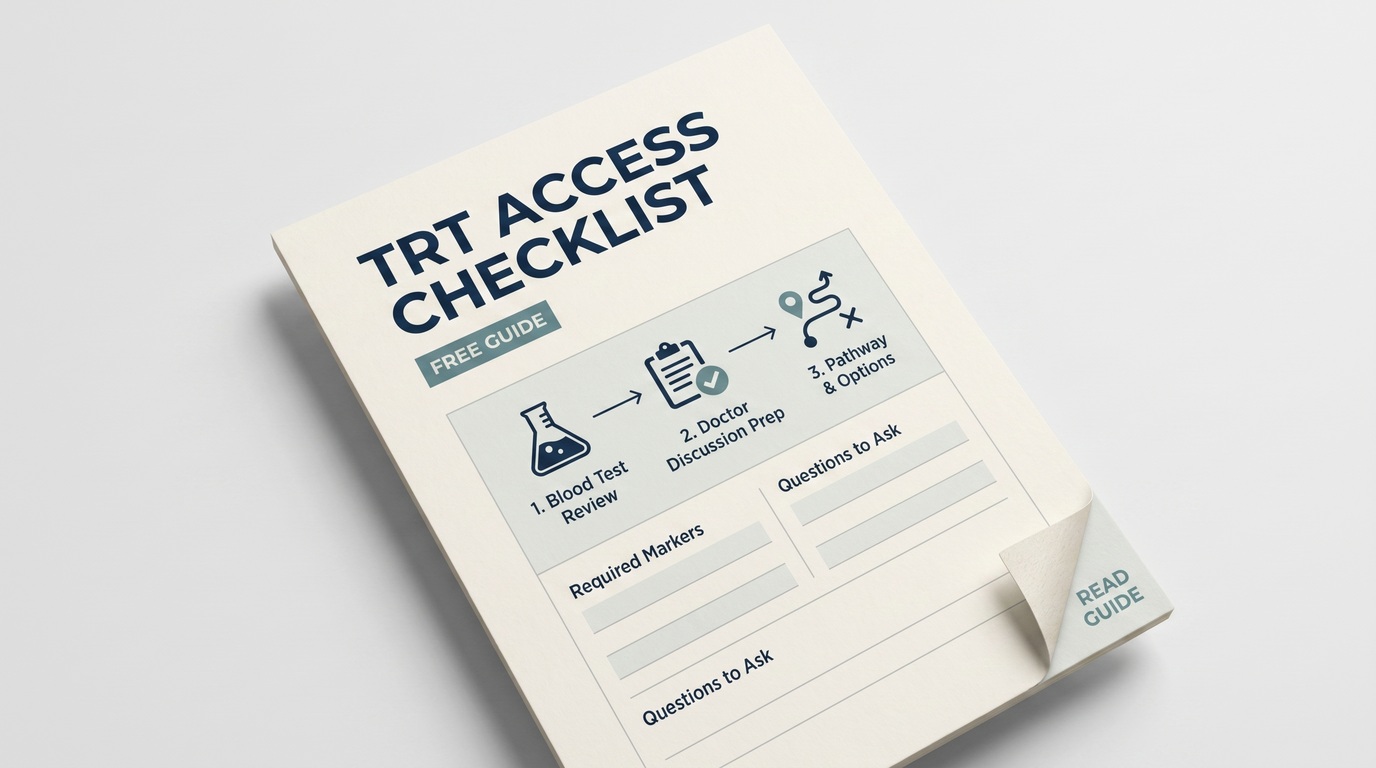
TRT Laws Australia 2026: Complete Legal Guide to Testosterone Therapy
What this should help you decide
- Use this to decide which symptoms, markers, or history points are worth raising with a clinician.
- Pay attention to the concrete markers mentioned here: testosterone, blood work.
- The practical parts are: Understanding the Legal Framework for TRT in Australia; Interstate Variations: State-by-State TRT Regulations; Importing TRT Medications: Customs & Border Control Laws.
- Do not treat the article as a dosing plan or a suitability decision.
These are the concrete topics this article touches. If a piece cannot produce this list, it is probably too vague.
TRT Laws Australia 2026: Complete Legal Guide to Testosterone Therapy
Last Updated: April 2026
Testosterone replacement therapy (TRT) occupies a complex legal space in Australia, governed by federal legislation, state-specific regulations, and evolving telehealth standards. As of 2026, understanding the legal framework separating therapeutic hormone optimisation from illegal anabolic steroid use is critical for Australian men seeking legitimate medical treatment.
This comprehensive guide examines the current legal landscape for TRT in Australia, covering federal legislation, interstate variations, customs regulations, and the critical distinctions between legal therapeutic use and criminal steroid possession.
Understanding the Legal Framework for TRT in Australia
Under the Therapeutic Goods Act 1989 (Cth) and the Poisons Standard (Schedule 4), testosterone and its derivatives are classified as prescription-only medicines. This means TRT is legal in Australia exclusively when:
- Prescribed by a registered medical practitioner (GP, endocrinologist, or urologist)
- Obtained from a licensed pharmacy (Australian or international)
- Used for documented medical conditions (hypogonadism, androgen deficiency)
- Administered under ongoing medical supervision with mandatory blood monitoring
Key Legal Classification: Testosterone preparations fall under Schedule 4 (Prescription Only) of the Poisons Standard, while certain high-potency formulations may be Schedule 8 (Controlled Drug) depending on the state and specific compound.
According to the Therapeutic Goods Administration (TGA) regulations updated in 2025, possessing or using testosterone without a valid prescription constitutes a criminal offence under the Criminal Code Act 1995 (Cth), carrying penalties of up to 2 years imprisonment or fines up to $11,000 for personal use violations.
Interstate Variations: State-by-State TRT Regulations
While federal law governs the therapeutic classification of testosterone, interstate variations in prescription practices, dispensing laws, and enforcement priorities create a patchwork regulatory environment across Australia in 2026.
| State/Territory | Prescription Validity | Dispensing Restrictions | 2026 Specific Requirements |
|---|---|---|---|
| New South Wales | 6 months (12 for chronic) | Repeat prescriptions require pharmacist verification of original medical records | Electronic prescribing mandatory for Schedule 4 hormones |
| Victoria | 6 months (12 for chronic) | Pharmacy must verify patient identity for Schedule 4 controlled substances | Mandatory reporting of testosterone prescriptions to Drug and Alcohol Office |
| Queensland | 3 months (6 for chronic) | Strict limits on compounded testosterone gels (max 3 months supply) | Additional endocrinologist referral required for TRT over 6 months |
| Western Australia | 6 months | Pharmacist must verify interstate prescriptions via National Prescribing Service | Enhanced monitoring for testosterone esters (cypionate, enanthate) |
| South Australia | 6 months | Electronic prescribing required for Schedule 4 substances | Mandatory blood work verification before dispensing |
| Tasmania | 12 months (chronic) | Pharmacist discretion on compounding testosterone gels | Relaxed telehealth prescription rules for rural patients |
| ACT | 6 months | Standard Schedule 4 dispensing rules | Integrated electronic health record system for hormone therapy |
Critical Interstate Note: Following the 2025 National Health and Medical Research Council (NHMRC) updates, prescriptions written in one state are valid nationwide for Schedule 4 substances, but pharmacists may refuse to dispense if they suspect the prescription doesn't meet their state's clinical governance standards.
Importing TRT Medications: Customs & Border Control Laws
For Australians seeking TRT from overseas sources or returning from international travel with testosterone medications, the legal framework is strict:
Personal Importation Thresholds
Under the TGA Import Regulations 2026, you may legally import:
- Up to 3 months supply of testosterone for personal use
- Only with a valid Australian prescription (must accompany shipment)
- Must declare to Australian Border Force (ABF) upon arrival
- Commercial quantities (over 3 months) require import permit from TGA
Prohibited Actions (2026 Enforcement Priorities):
- Importing via unregistered couriers (common seizure method)
- Bringing testosterone across borders without prescription documentation
- Using commercial shipping services without proper declarations
- Importing compounded formulations not approved by TGA
Recent Case Law: In March 2026, the Federal Court upheld convictions against three individuals who imported testosterone cypionate from overseas pharmacies without TGA approval, resulting in confiscation of goods and criminal charges under the Customs Act 1901.
Therapeutic TRT vs Anabolic Steroid Abuse: The Legal Distinction
The legal boundary between therapeutic TRT and illegal anabolic steroid use rests on three critical factors under Australian law:
- Medical Indication: Valid prescription requires documented androgen deficiency (blood testosterone <8 nmol/L on two separate occasions) or other TGA-approved indications (hypogonadism, certain cancers, muscle-wasting diseases)
- Medical Supervision: Legal TRT requires ongoing monitoring (hematocrit, PSA, liver enzymes, testosterone levels) every 3-6 months
- Formulation: Only TGA-approved formulations (gels, injections, pellets) are legal; unapproved compounds or "designer steroids" constitute Schedule 8 controlled substances
The "Therapeutic Use Exemption" (TUE): Athletes may legally use TRT under strict TUE protocols approved by the Australian Sports Drug Testing Laboratory (ASDTL), but this requires prior approval before competition—retroactive TUEs are not recognised.
Legal Risk Warning: Using TRT for "biohacking," "anti-aging," or performance enhancement without documented medical necessity violates the Therapeutic Goods Act, even with a prescription. Doctors who prescribe TRT without documented hypogonadism risk prosecution for professional misconduct.
Telehealth Prescriptions & Online TRT: 2026 Regulatory Standards
Following the 2024-2025 permanent telehealth reforms, online TRT prescriptions are legal nationwide under specific conditions:
Current Telehealth Requirements for TRT (2026):
- Initial consultation: Must include physical examination or comprehensive video examination with pulse oximetry, blood pressure monitoring, and genital examination capability
- Follow-up consultations: Can be purely telehealth if patient has established treatment history and recent blood work (<6 months)
- Interstate prescribing: Doctors can prescribe across state lines but must comply with the patient's state dispensing laws
- Electronic prescribing: Mandatory use of e-Prescribing system (e-Rx) for all Schedule 4 hormones
Illegal Online TRT Models: "Quick test, quick script" services offering TRT without proper medical assessment, blood testing, or ongoing monitoring violate the Health Practitioner Regulation National Law. The Medical Board of Australia's 2025 crackdown on "testosterone mills" has resulted in multiple practitioner deregistrations.
Medicare Coverage & PBS Eligibility for TRT
Understanding Medicare coverage is crucial for the legal financial aspects of TRT:
Medicare Benefits (MBS) Items:
- Item 73000: Endocrine consultation for hormone deficiency ($83.20 rebate in 2026)
- Item 73001: Follow-up consultation ($41.60 rebate)
- Item 73002: Specialist endocrinologist consultation ($166.40 rebate)
Pharmaceutical Benefits Scheme (PBS): Most testosterone formulations are NOT PBS-listed, meaning patients pay full private prescription prices ($80-$150 per month for gels, $50-$120 for injections). Some compounded gels may qualify for PBS under specific circumstances (item numbers vary by state).
Private Health Insurance: TRT is generally classified as "pharmaceutical benefit" rather than "hospital benefit," meaning comprehensive hospital policies may not cover the cost of testosterone itself, though they may cover specialist consultations.
Legal Requirements for TRT Clinics & Practitioners
For clinics offering TRT legally in 2026, the following standards apply:
Practitioner Requirements:
- Registration: Must be registered with the Medical Board of Australia
- Scope of Practice: GPs can prescribe TRT but complex cases require endocrinologist oversight
- Continuing Education: Mandatory 2-hour annual training on hormone therapy and controlled substances
Clinic Accreditation Standards:
- RACGP Standards: Clinics must meet Royal Australian College of General Practitioners quality standards for chronic disease management
- Record Retention: Minimum 7 years of medical records retention (10 years for Schedule 4 substances)
- Pharmacy Partnerships: Must work with licensed pharmacies; "in-house compounding" requires specific pharmacy license
Documentation Requirements:
Legal TRT practice requires documented:
- Two separate morning testosterone blood tests (<8 nmol/L)
- PSA testing for men over 45
- Baseline hematocrit (<54% required for initiation)
- Cardiac risk assessment
- Consent forms acknowledging fertility risks
FAQ: Common Legal Questions About TRT in Australia
Is it legal to bring testosterone into Australia?
Yes, but strictly limited. You may bring up to 3 months supply for personal use with a valid Australian prescription. You must declare the medication to Australian Border Force upon arrival. Commercial quantities or amounts exceeding 3 months require a TGA import permit. Undeclared testosterone can result in confiscation and criminal charges.
Can you take TRT legally?
Yes, TRT is legal when prescribed by a registered medical practitioner for documented medical conditions (hypogonadism, androgen deficiency). It is illegal to possess, use, or distribute testosterone without a valid prescription. The legal distinction rests on medical necessity, ongoing supervision, and TGA-approved formulations.
How does TRT work in Australia?
TRT in Australia follows a strict medical pathway: (1) Medical assessment for symptoms of low testosterone, (2) Two separate blood tests confirming levels <8 nmol/L, (3) Prescription by registered practitioner, (4) Dispensing through licensed pharmacy, (5) Ongoing monitoring every 3-6 months. Telehealth prescriptions are legal but require physical examination capability for initial consultations.
Does Medicare cover TRT in Australia?
Medicare covers consultations (Items 73000-73002) but NOT the cost of testosterone medication itself. Most TRT formulations are not on the PBS, meaning patients pay full private prescription prices ($80-$150 monthly for gels, $50-$120 for injections). Private health insurance rarely covers the medication cost but may cover specialist consultations.
What are the legal penalties for illegal TRT use?
Unlawful possession of Schedule 4 medicines carries penalties up to 2 years imprisonment or $11,000 fines. Distribution or sale without a license carries up to 10 years imprisonment. Importing without declaration can result in confiscation and criminal prosecution under the Customs Act.
Can I get TRT online legally in 2026?
Yes, through legitimate telehealth services that comply with Medical Board of Australia standards. Legal online TRT requires: (1) Physical examination capability during initial consultation, (2) Proper blood testing, (3) Valid electronic prescription via e-Rx system, (4) Dispensing through licensed pharmacies. "Quick script" services without medical assessment are illegal.
Conclusion: Navigating TRT Legally in 2026
The legal framework for TRT in Australia remains strict but accessible for legitimate medical needs. As of 2026, the key to legal TRT is working within the established medical system: documented diagnosis, registered practitioners, licensed pharmacies, and ongoing monitoring. The distinction between therapeutic hormone optimisation and illegal steroid use is narrow but significant—crossing it risks not only health but legal consequences.
For Australian men seeking TRT, understanding these laws ensures safe, legal access to life-changing treatment while avoiding the criminal penalties associated with unregulated hormone use.
Disclaimer: This article provides general information about TRT laws in Australia as of April 2026. It does not constitute legal or medical advice. Consult a qualified medical practitioner and legal professional for specific guidance regarding your situation. Laws and regulations may change—verify current requirements with the Therapeutic Goods Administration (TGA) and your state health department.
Questions to ask before acting on this
Use this as a filter before you bookmark, share, or act on the article.
- 1
What symptom, lab marker, or risk does this change?
- 2
Which baseline tests should be checked before any treatment decision?
- 3
What would make this unsuitable for me?
- 4
What follow-up or monitoring would a clinician expect?
The caveat that keeps this useful
Treatment choices need a clinician who can see your history, medication use, blood work, and risk factors. A blog post should help you ask better questions, not self-prescribe.
Want this reviewed properly?
Use the assessment to give the clinic context before a doctor reviews suitability. It does not replace clinical advice.